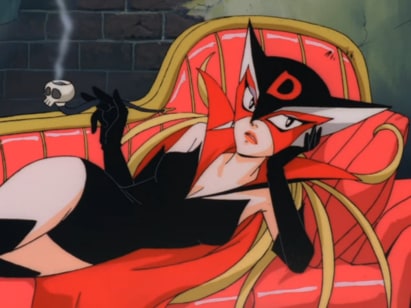
With her long, golden blonde hair and sparkling pink eye chips – not to mention her elaborate stock outfit – Doronjo x Blythe is certainly one of the most striking Neo Blythe releases ever. And it doesn’t hurt that she’s gorgeous beyond belief. Released in early 2009 as a limited edition of 3000 dolls, her price on the secondary market quickly doubled – and even now, she’s far from cheap. She’s a beautiful doll – but what’s her story?
The Doronjo doll was modeled after one of the villains in Yatterman, the longest and most memorable anime series in Tatsunoko’s Time Bokan franchise. The plot is relatively simple – thirteen-year-old Gan-chan, the son of a famous toy designer, and his girlfriend Ai-chan are the heroes of the show, masked crime fighters who call themselves Yatterman-1 and Yatterman-2. Their nemesis is the Doronbo Gang – and its leader, Doronjo. As Doronjo follows her boss’s orders to find the Dokuro stones – mysterious stones which are said to have the power to reveal a very valuable treasure – her plans are consistently foiled by Yatterman-1 and Yatterman-2.
The original Yatterman television series debuted in Japan in January of 1977 and ran for two years. The show was enormously popular, but it wasn’t always the heroes the audience was cheering for – it was the hilariously inept Doronbo Gang.
The Yatterman animated series was remade in 2008, followed in 2009 by a live-action feature film directed by Takashi Miike, known primarily overseas for gruesome films like Audition and Ichi the Killer.
It makes sense, then, that a collaboration between Yatterman and Blythe would result in a doll bearing the likeness of arguably the most popular and memorable character of the franchise, the stunningly beautiful – yet vain – Doronjo.
I find it useful when searching to use the Japanese characters for Blythe dolls. Here are some I have found. They may be spelt incorrectly but without the boxes I cannot check.
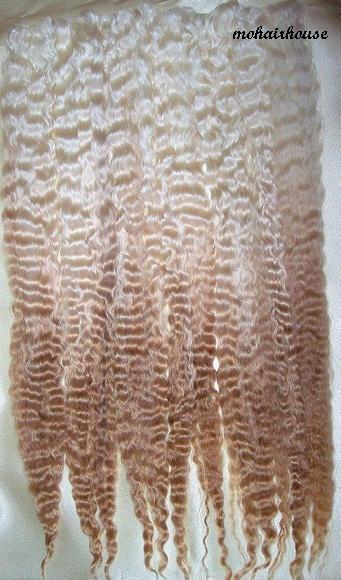
I first got in contact with Sue Coyle of mohairhouse.com on Google+ of all places. We got chatting and I discovered that Sue was well acquainted with Blythe dolls and their needs when it comes to mohair for re-roots. Describing herself as “just a country girl”, Sue first got into mohair when she was restoring vintage troll dolls. After months of work devising her own process for turning raw unwashed wool into a finished, combed product she started selling her left over mohair in her online store on etsy. Sue cares for a pack of 21 angora goats that provide all of the mohair available in her store. Mohairhouse sells mohair in natural or vivid colours including Sue’s own original colour blends.
Ask any group of Blythe collectors what their least favorite face mold is and you’ll get an almost unanimous answer: SBL. They look too mature compared to the child-like BLs and EBLs, they’ll say. The eye holes are too small and their knowing smirks look like the Joker’s devilish grin. And opening an SBL usually requires an abundance of patience and a lot of prying and soaking – and sometimes even a saw.
So I understand why a lot of collectors and customizers aren’t very fond of the SBLs – and besides, there’s no accounting for taste, especially in the Blythe world.
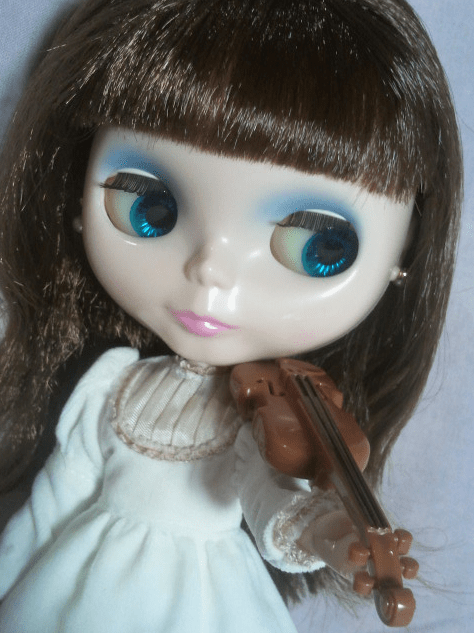
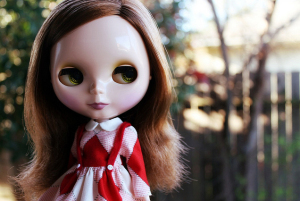
The SBL – S for Superior – face mold was introduced in 2003 and was the first true new face design for Neo Blythe. The earlier BL and EBL (Excellent) dolls shared the same face mold while having minor differences in the eye mechanism and body type. SBL dolls were intended to more closely resemble the original Kenners – in fact, during the design process, CWC/Takara used scans of a Kenner head when creating the mold. With her smaller eyes, narrower chin, and completely redesigned eyeball structure, the first SBL release – Superior Skate Date – was radically different than any of the previously released Neo Blythe dolls, despite being a reissue of an earlier EBL release.
The Kenner inspiration didn’t end with the design of the new face mold. With many of the early SBL releases, CWC went full-on 1972 – dolls like Very Inspired by Pow Wow Poncho, Lounging Lovely, and I Love You It’s True came with outfits that looked as if they were lifted right out of The Brady Bunch, vivid yellow-green eyeshadow, and classic Kenner hair colors. However, as more and more dolls were released the designs began to drift further and further away from the Kenner aesthetic and toward more original concepts.
This is why I love the SBLs so much. The first few years of SBL releases represent to me CWC and Takara’s peak in creativity and quality. Looking at the releases from the very first SBL in November of 2003 up until the introduction of Darling Diva, the first RBL release and 2006’s anniversary doll, I can find little to complain about.
As much I like some of the newer releases, you don’t get as much with a brand new Blythe as you used to. You get a doll, one complete outfit, some cheap panties (seriously, it’s like someone took a piece of cloth and hacked out a panty-shaped object with a pair of rusty scissors) and – if you’re lucky – a special set of eye chips. The designs are wonderful but the execution is flawed, and as the cost of production rises, sacrifices must be made to keep the dolls at their current retail prices.
But let’s go back a few years. Let’s go back to 2004, which saw the release of dolls like Happy Every Day by Over the Stripes, Art Attack, Mitten, Paradis by Mono Comme Ca, Lil’ Heart by Milk, Lounging Lovely, and Groovy Groove. Have you ever de-boxed one of these dolls? You didn’t just get a doll with one outfit – you got a doll, two or three full outfits, a full set of underwear, multiple pairs of shoes, and tons of cool accessories – record players, coffee mugs, straw hats, goggles. Mitten came a Petite Blythe, and Lil’ Heart had her own fancy carrying case. And for the most part these dolls were similar in price to the current releases. A regular release like Birdie Blue cost just a bit over $100 USD (¥10,290) and limited releases like Roxy Baby or Tommy february6 were between $160 and $200 at retail. Only with the anniversary dolls and special releases like Mitten did the prices skyrocket. Art Attack at retail was a whopping ¥35,000 (approximately $370 USD) but for that price you got a really freaking neat doll with a short blue bob, bright make up, and special eye chips plus a ton of outfits and accessories. Seriously. That doll came with, like, five or six different outfits and multiple pairs of glasses and earrings. And a CD-ROM with a screensaver.
And most importantly, each release was unique. These dolls had their own distinct themes, from the 70s-inspired chic of Inspired by Pinafore Purple and the Alice in Wonderland-themed Cute and Curious to collaborations with Japanese clothing lines (Over the Stripes) and pop singers (Tommy february6) to… well, dolls like Groovy Groove and Good Neighbor Café that didn’t necessarily make a whole lot of sense. CWC wasn’t scared to play around with bold make up – bright blue eyeshadow, orange blush, brown lipstick – and new hairstyles – rounded bangs, two-toned bobs, bright fantasy colors.
These dolls didn’t just have cute outfits, fun accessories, and interesting haircuts – they had personalities.
The SBL wave also saw the introduction of a new type of Blythe release – the Prima Dollies. The Prima Dolly series (which seems to have now been replaced with the Simply series) consisted of simple dolls in simple outfits at a reasonable price. Ashlette, Ginger, and Violet, the first three releases, cost only ¥7.875 (around $82 USD) each and made a great “starter” Blythe for new collectors or an affordable base doll for customizers.
I don’t want to look back on these middle years of Neo Blythe through rose-colored glasses. Many of the SBLs were not without their faults. I’ve already mentioned the difficulties customizers face in opening up an SBL head – they are notoriously stubborn and many customizers refuse to even work on them. The first four SBLs – Superior Skate Date, Pow Wow Poncho, Velvet Minuet, and Sunday’s Very Best – had extreme downward sidelong glances, a problem that could only be remedied by – you guessed it – opening up the head and filing down the T-bar. The default lip shape also seemed to change on the later dolls, giving them a definite smile that many collectors disliked.
CWC and Takara Tomy would go on to fix the issue of opening Blythe’s head with the RBL mold, which could simply be unscrewed and popped apart. Once the RBL mold was introduced, most of the more interesting designs and concepts were understandably released in the newer mold, and the later SBL releases (Ashletina, Frosty Frock) were overshadowed by the elaborately designed older dolls or by the then-current hugely popular RBL releases like Princess a la Mode, Mrs. Retro Mama, and Heart of Montmartre.
The final SBL dolls were released in December of 2008, and in May of the following year Takara Tomy announced that the production mold had been irreparably damaged and would never be used again. I hadn’t yet bought my first doll then, but having gone back and read old message board threads and blog posts, the overall reaction in the community seemed to be either a great big sigh of relief or complete indifference. And I can’t really blame them – it was time for Neo Blythe to move on.
The SBL mold lasted five years. We’re now in the seventh year of the RBL mold, and while it isn’t a particularly popular opinion, I have noticed a handful of collectors getting tired of one RBL release after another while the FBL mold – which hasn’t exactly been warmly received – sits on the sidelines, used sparingly for releases that are usually met with lukewarm responses.
For collectors like me, the near-universal dislike or indifference toward the SBL releases is actually a good thing. While people go crazy for customs and translucent RBLs like Miss Sally Rice and Margo Unique Girl (who, amazingly, is now selling on the secondary market for more than Princess a la Mode) I can snap up many of the SBL releases for $150 or less – sometimes even under $100, like my recently-acquired Never-Removed-From-Box Lounging Lovely.
There is undoubtedly something out there in the Blythe world for every collector. For some it’s elaborate custom dolls. For others, mint Kenners.
But for me, a big part of my heart belongs to the SBLs. The S is for Superior, after all.



 BLYTHOPIA